A month of journalling
In a recent digest I linked to Herman’s post post about resurfacing old blogs. In that entry, the posts he chose to resurface were the ones about his journalling[1] journey, and this inspired me to have a go.
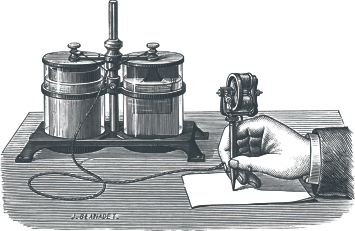
Of course, I’ve tried it before, but I’ve never got very far. I did used to be a fairly keen bullet journaller (in the original, minimalist sense of a particular method for organising daily lists of bullet points), but I don’t feel that counts as much. The originator Ryder Caroll calls it a “mindfulness practice disguised as a productivity system”, but if I’m honest, to me it was more of a productivity system.
To my surprise, by the end of today I’ll have written an entry for every day for a whole month. Not all of them were written on the day, admittedly. If I was busy or tired that evening, I just did it the next morning. But the entries for each day are there. I don’t think I’ve ever kept up a journalling habit this long.
I’ve tried both paper and digital journalling, and neither have stuck. The advantages of both are clear. Paper journalling is more low-tech, with less chance of distraction, more adapted to that intentional, reflective state journalling is supposed to inspire (as well as the supposed cognitive benefits of handwriting). A digital journal is easier to back up and search if you like, and it doesn’t take up physical space. It’s also quicker to write if you are fast at typing.
The format that has really helped it stick for me is the one that Herman uses for his own practice — One Big Text File (OBTF). I’m a plain-text kind of guy, but when I’ve tried journalling, I’ve generally tried one file per day (seriously, my journal folder is full of sporadic attempts, each evident from a sequence of dated files that fizzles out after a handful of entries). I’ve heard of people using OBTF for blogging and note-taking, but strangely, never journalling. Once I heard about this method, I did search for other people’s approaches, and found this one, but honestly this sounds overcomplicated, and like it’s trying to quantify and optimise the ineffable benefits of journalling by adding tags like “#clarity”.[2]
Why has this version stuck so well? Firstly, it’s very low-friction. It’s also satisfying to see the file grow. I can also see easily see where I left off yesterday in case I want to continue that line of thought, similar to a paper journal. And look, I still see the appeal of the paper journal. But it’s better to have a format that actually works for me than the “ideal” system.
Here’s what I do. My journal is a markdown file, synchronised across devices using Syncthing. On my computer, I have simply aliased j in my fish shell to jump straight into my journal in Neovim (together with a keybind to launch the terminal, it takes about 1.5 seconds to start writing).[3] On my phone, I use Markor, a great markdown editor that also loads very quickly and sorts files by most recent, so my journal is pretty much always accessible in the top 3 most recently edited files. My Neovim has a LuaSnip snippet to insert today’s date as an h2 heading, and Markor has a UI button to insert the date in a configurable format. Either way, it’s extremely easy to get going, there’s no fiddling about creating files. I mainly write on my phone, to be honest. I can easily do it whenever I’m sitting down, or even between sets at the gym.
My entries vary in length. I don’t put any pressure on myself to achieve a certain wordcount. Sometimes they’re just a one-paragraph breakdown of my day, but often they’re more introspective. These ones tend to be a bit longer. But they’re the ones that really count. It’s true what people say — journalling really can be like self-therapy. I am already finding benefit in writing down the things that are worrying me and examining them, or working through other difficult emotions, or giving myself a pat on the back when I’ve made progress on managing something that was bothering me before.
Anyway, it’s still early days in the grand scheme of journalling, but so far, this is a practice I’d recommend to anyone. Try paper, try an app, or just try maintaining a single text file. Whatever works for you.
For this post, I’ve had to decide whether to use the British “journalling” or American “journaling”. I think I’m more used the American spelling up to now because I’ve seen so much online content about the merits of journal(l)ing from American creators. But after umming-and-ahhing for a few minutes, both spellings now look wrong to me, so I’ve just gone with my native spelling for this post. ↩︎
Also, the “#course-seed” tag is very niche, but the guy who made this system is apparently working on a very niche course about reducing your exposure to WiFi and other forms of radiation. ↩︎
I do realise that most normal people would just stick a shortcut to
journal.mdon their desktop and be able to access the file just as efficiently, but I’m very far down the Linux rabbit hole and do not even have a desktop on my laptop (I useswaywm). ↩︎