What is a tangent space, anyway?
My site is called the Tangent Space. This is something of a pun, on the fact I am prone to tangents and parentheticals. But actually, the tangent space is a concept in mathematics.
Tangent spaces come up in both differential and algebraic geometry. They’re easier to understand in differential geometry though, so that will be the focus of this post.[1] There are actually several ways to define tangent spaces, that are best suited to different contexts (and in “good” situations, the different definitions are compatible).
Differential geometry studies structures called manifolds. A manifold is some kind of geometric object in which near every point there is a local coordinate system.
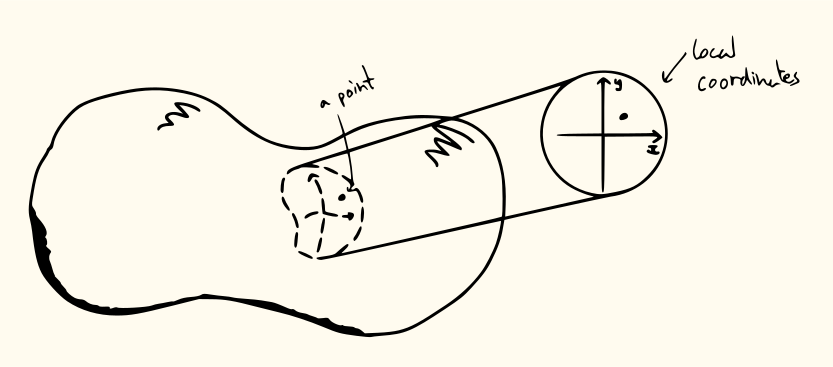
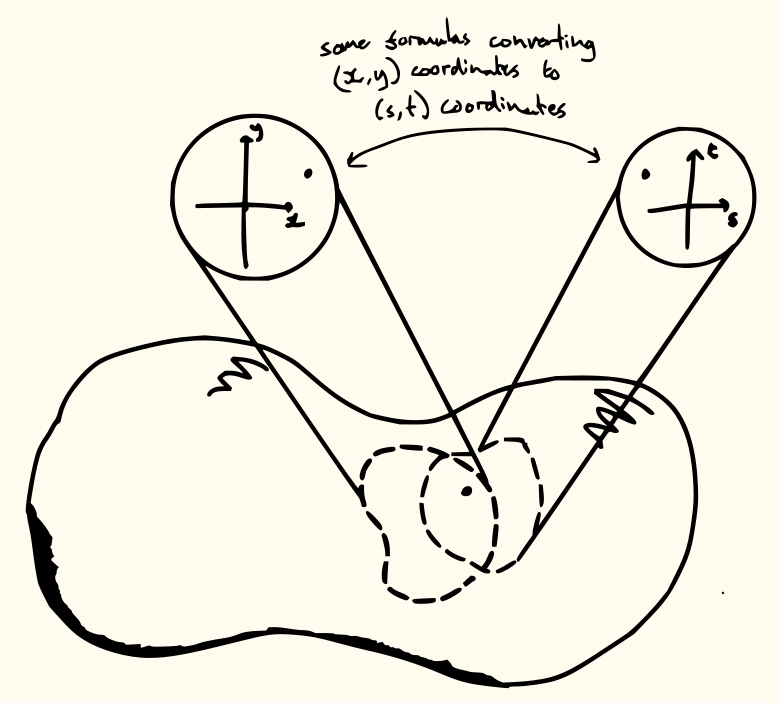
Also, we should know how to transition between the coordinates for one region and another when they overlap. Each coordinate system is called a chart, and the collection of charts covering the whole manifold is called an atlas.
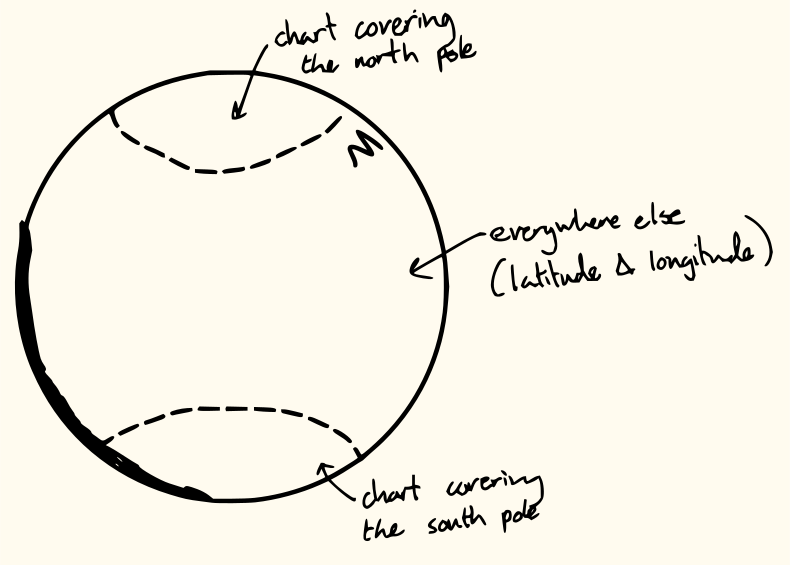
A good first example of a manifold is the surface of a sphere — for example, the Earth. We cannot give a coordinate system that covers the entire Earth — we can use latitude and longitude for most points, but actually, the North and South Poles don’t have a longitude! But when we’re standing on the North or South Poles, we can use a different coordinate system, and then give mathematical formulas for how to convert between North/South Pole coordinates and latitude and longitude coordinates.[2]
The dimension of a manifold is how many numbers are needed for your coordinate systems. So while in everyday language we’d say the surface of the Earth is 3d, in the language of manifolds, it’s 2d, because each coordinate system requires two coordinates (e.g. latitude and longitude). In this post the drawings are all of 2d manifolds because, well, that’s what I can draw.
A key feature of the definition of a manifold is it doesn’t make any reference to what’s “outside” the manifold. When we imagine a sphere such as the Earth, we’re probably imagining it suspended in some kind of 3d space (in the case of Earth, this would be actual space). But in the case of manifolds, there doesn’t need to be a larger space for them to live in. In fact, we may not even really know what the large-scale structure is like, but we can still describe the manifold by describing each chart and how they fit together. It’s a bit like how in a video game there may not even be anything outside of the level, and the global structure of the level may only be defined by how the different rooms in the level connect together, rather than the game modelling the entire level inside some 3d ambient space.
The point is, this is a very flexible kind of object, that comes up throughout mathematics and physics. Even a simple line can be considered as a 1d manifold. When people say “time is the fourth dimension”, they’re (probably unknowingly) referencing Einstein’s theory of relativity, in which space-time is a four-dimensional manifold, where one of those dimensions is considered “time-like”.[3]
Now we’re ready to look at tangent spaces. You may recall from elementary geometry that a tangent to a circle is a line that touches the circle at exactly one point, or you may know from calculus that the derivative gives the gradient of a tangent line to a curve at a point.
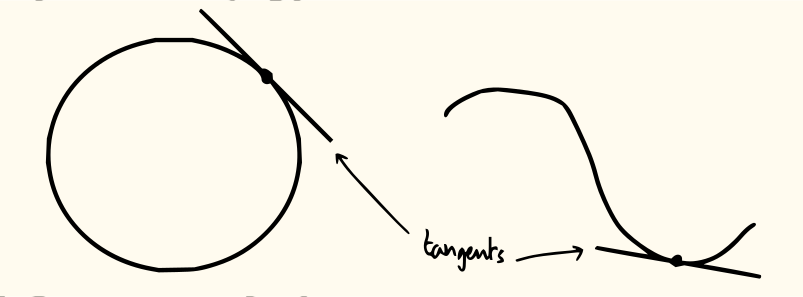
In both cases, the idea is that the tangent line is like a completely flat approximation of the curve at that point. We want to do the same for manifolds. Looking back at the sphere example, could we not just slap a completely flat plane onto the sphere as a flat approximation near a point?
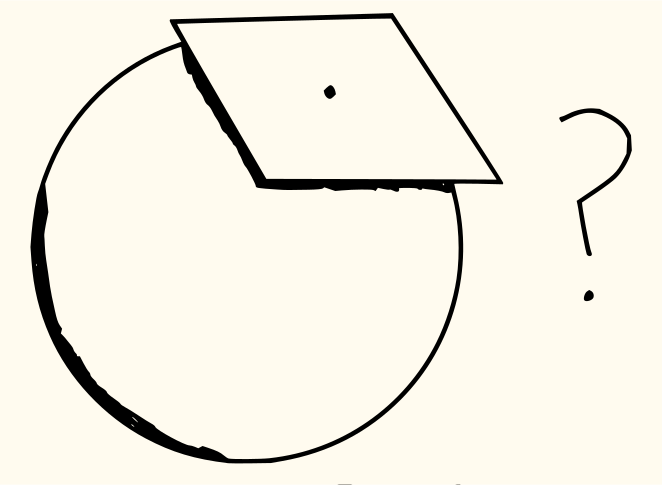
Well, it’s a nice idea, but this has a problem — it depends on there being an outside space for the plane to live in alongside the sphere, but manifolds do not require there to be an outside space.
Let’s see one way of building a tangent space without any reference to anything outside the manifold. let p be a point in a manifold. We can look at paths through the manifold that pass through p. A tangent vector at p, or simply a tangent at p, is a possible velocity (i.e. speed and direction) one can be travelling along a path at the moment that path passes through p.[4] We can imagine it as a little arrow extending from p.
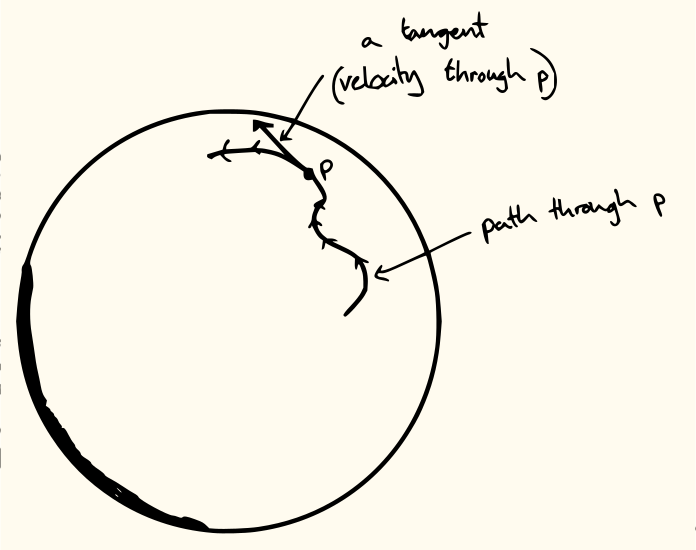
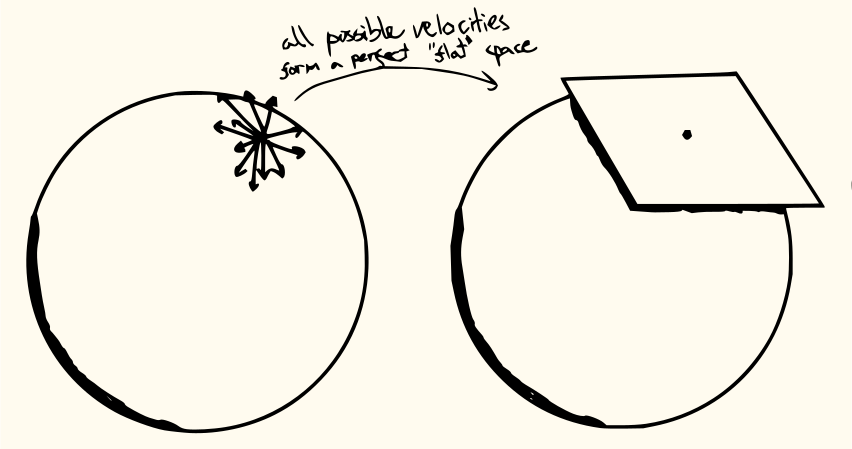
The collection of all possible tangent vectors (from all possible paths) through p is called the tangent space at p. It is a space of the same dimension as the manifold, but it is perfectly “flat”, as it is made up of velocities, which point straight in a single direction; they do not curve, even if the manifold does. It is more-or-less perfectly safe to return to the mental image of a flat plane touching the manifold — all the arrows together form a plane.[5]
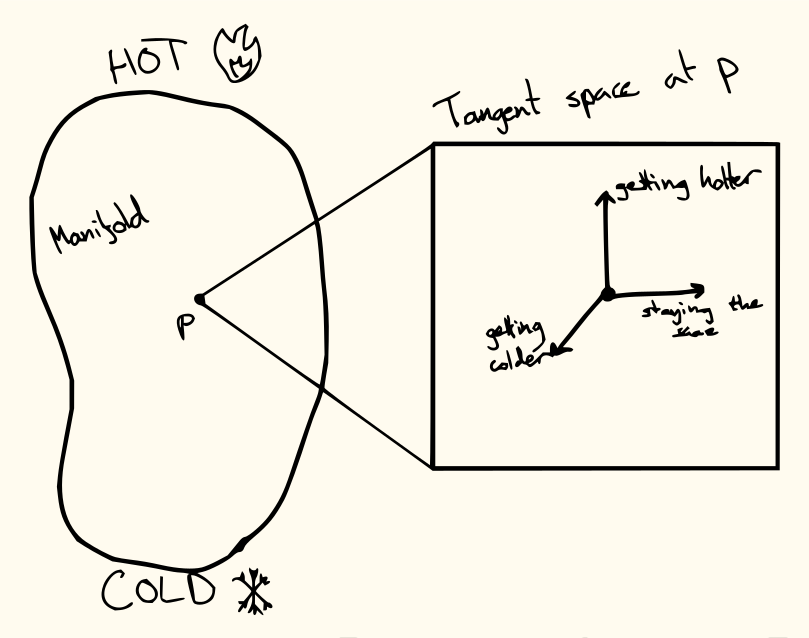
The tangent space can be used to do a lot of stuff, much of it too technical to try and describe here, but the basic idea is it provides information about what is going on very near p.[6] For example, let’s say we have some value that varies from point to point across the manifold.[7] As an example, we can think of temperature — as you move around the manifold, the temperature might vary. We can use the tangent space to measure how much the temperature is changing in each direction around p.[8]
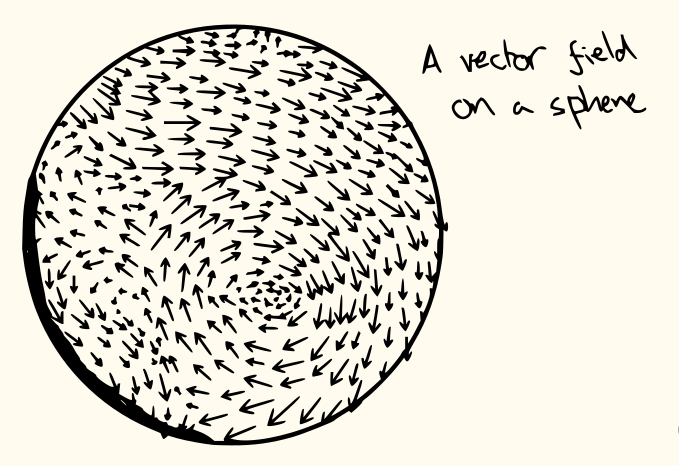
One essential use of the tangent space is considering not the tangent space at p in isolation, but the tangent space at every point of a manifold, or at least some part of the manifold. By selecting a tangent at every point of the manifold, we obtain what is called a vector field. Vector fields can be used to model fluid flow around a manifold (and since many real-world spaces can be modelled as manifolds, we can use this to model fluid flow in real life).
The tangent spaces to every point on a manifold can actually be stitched together to form a whole new manifold, called the tangent bundle of the manifold. Let M be the original manifold and TM be its tangent bundle. How could we specify a point on this tangent bundle? Well, each point of TM corresponds to a tangent in some tangent space of M, so we need to specify which tangent space of M the point lies in, and then which tangent vector of that tangent space. If the original manifold M is n-dimensional, then specifying which tangent space is an n-dimensional problem. And then since the tangent space at that point of M is also n-dimensional, we then need another n-dimensions to fully specify a point of TM. This means that all together, TM is 2n-dimensional, twice the dimension of M.[9]
The purpose of the tangent bundle TM is it encodes all the possible vector fields on M. Since TM is made of all the tangent spaces of M, a vector field is a “slice” of TM that touches each tangent space of M exactly once, thus selecting a tangent vector at each point.
I’m just waiting for when I can use the name “theTangentBundle” for something on this site :).
Also despite doing more algebraic geometry in my studies, my intuition for the Zariski tangent space (the algebraic version) is much weaker. ↩︎
I’m lying very slightly here. Longitude has the problem that at some point it has to “reset”, going from 180 to -180 degrees, and on this meridian there wouldn’t be a well-defined coordinate system. So we’d actually need one more chart to cover this line. ↩︎
It is not quite correct to say that the 4th dimension is time, even though it is traditionally denoted t. What we experience as time is described as a path through spacetime, and the duration we experience is the length of the path. However, since everything in our everyday experience moves slowly (compared to the speed of light) in the space-like dimensions, almost all of our motion through spacetime is time-like, so the time-like dimension is approximately what we experience as time. This approximation fails when we are talking about objects close to lightspeed, where effects like time dilation are noticeable. ↩︎
The word velocity is used because it is so closely analogous to velocity in physics. Anyone who took physics or calculus will know that velocity is the derivative with respect to time. In this context, velocity is still the derivative, but the variable isn’t necessarily interpreted as time. ↩︎
And this is obviously a vector space, if you know what that is. ↩︎
“Very near” might sound a bit loose, but in a technical sense, we mean things that, once we are within a certain neighbourhood of p, don’t change no matter how close to p we get. ↩︎
I’m talking about a function, of course. ↩︎
If you’ve done multivariable calculus, I’m talking about the directional derivative, of course. In fact, an alternative way to construct the tangent space is to define operators that behave like directional derivatives (derivations) and take the tangent space to be the set of derivations at p. ↩︎
Unfortunately this means only extremely basic examples of tangent bundles can be physically visualised, as the highest even dimension we can imagine is 2, meaning we can only imagine tangent bundles over 1d manifolds. ↩︎